Architecture
Four namespaces, four layers
demo.core requires four glitter-uikit namespaces, each a distinct layer. app is the NSApplication bootstrap: the run loop and the cross-thread marshalling that lets a swap! from anywhere, an nREPL eval included, land safely on the AppKit main thread. appkit is the IRender implementation that mounts hiccup into a window. ffi is raw objc_msgSend plus helpers, aliased u by convention. widget is the widget factory and the shared ObjC target class, which the app reuses directly for its own hand-rolled buttons (see AppKit integration). glitter.core is the toolkit-agnostic reconciler underneath all of it, and jolt.ffi is Jolt's own FFI layer, required directly wherever the app needs to bind a CoreFoundation function glitter-uikit's ffi doesn't wrap.
demo.registry is the seam that makes the multi-window structure work, described below. demo.examples.* are the four example namespaces, each joining the hub with one require line in demo.core.
The registry: two open multimethods
An example has to register itself with the hub, and the action dispatcher has to accept kinds it has never heard of. Both are open problems, so both live in demo.registry, a namespace small enough that every example notebook can require it without creating a dependency cycle (demo.core requires the examples, and the examples require only demo.registry, never demo.core).
Two multimethods carry the pattern:
run-action!dispatches on an action's kind. Each exampledefmethods its own actions right next to the feature they serve, instead of collecting them in one growingcase.action-specreturns the spec for each kind and knits every example's contribution into one open spec withs/multi-spec, so validation stays ahead of every FFI call. An unknown kind has no method and is invalid by construction: a typo in an:on {:click ...}vector produces a loudexplain, not a silently swallowed no-op.
This grew out of something simpler that stopped working. The app's first dispatcher was a closed case over a closed s/or spec, which served fine while there was one example. It couldn't learn a kind it had never seen, so it couldn't survive the hub. The shape is worth remembering, because every closed dispatcher looks reasonable right before it needs to grow.
State, view, actions
Every window follows Replicant's pattern: one atom holds the world, mount! watches it, and each swap! re-reconciles the view. The renderer marshals that reconciliation onto the AppKit main thread, so the swap itself is safe to call from anywhere.
Views are pure state -> hiccup functions. :vbox and :hbox are literally NSStackViews with the orientation preset, and a bare string child becomes its own NSTextField label, so ordinary stack view behavior applies throughout. Two conventions appear in every view: :margin sets edge insets on the stack, and :markup takes Pango-style hiccup ([:span {:size "large" :weight "bold"} ...]) rendered to an NSAttributedString.
Events carry pure data, [[:action/inc]], and the one dispatcher interprets them, checking the whole batch against ::actions before running any handler in it. The event map each handler receives also carries :glitter/appkit-view, the raw sender pointer, as an escape hatch into AppKit when a handler genuinely needs it.
One gotcha worth flagging up front, because it cost a real bug in the Currency Converter: an entry's typed value arrives as :glitter/value, but one level down from where you'd look. The renderer puts :glitter/value in its raw event map, and glitter.core/build-event-map nests that whole map under :glitter/dom-event before the dispatcher ever sees it. event-value in demo.registry does the get-in once so no example has to rediscover this.
Mounting a second window
appkit/mount! watches its state atom under a hardcoded key, ::appkit/render. Clojure's add-watch is last-writer-wins per key, so a second mount! call on the same atom silently replaces the first window's watch, and that window stops re-rendering. Every window this app opens beyond the hub, the Preferences window and each example window, calls mount-second! instead, which is mount!'s wiring verbatim with the watch key taken as a parameter. Each open example window keeps its own key, (keyword "demo.example" (name id)), so opening a second example never displaces the first.
Dataflow
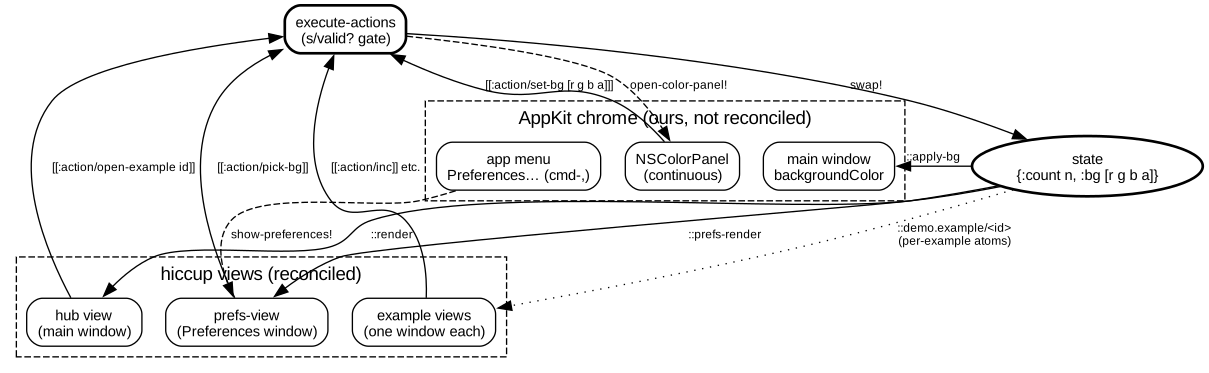
Actions flow from any window into execute-actions, which validates the batch and dispatches each one. A handler either swaps state directly or, for the two effectful preferences actions, reaches into AppKit chrome the reconciler doesn't own (opening the shared NSColorPanel, showing the Preferences window). One swap! then fans out through three independently keyed watches: the hub's own render, the Preferences window's render, and a plain background-color watch that sets the main window's backgroundColor directly, since that property is chrome the reconciler never touches.